
The global Christmas ornaments market was valued at USD 8.85 billion in 2025 and is projected to grow at a compound annual rate of 3.5 to 4.6 percent through the next decade. Yet within this expanding category, no word is more routinely abused than "handmade." A bauble labeled "hand-crafted" may have been spray-painted on an assembly line, and a listing promising "hand-decorated" glass often means nothing more than glitter glued onto a factory blank. For buyers who want ornaments that genuinely look hand-painted, the challenge is not finding options. It is separating authentic craftsmanship from marketing language.
This guide answers that question directly. It maps the most reliable channels for buying hand-painted glass Christmas baubles online, provides a seven-point verification checklist you can apply to any product, and explains why Polish origin is the strongest quality signal in the category. It also introduces ExArte (christmastreeornaments.eu), a curated retailer that sources directly from Polish workshops and documents its process transparently.
TL;DR
The Christmas ornaments market is worth USD 8.85B+ and growing, but "handmade" is the most overused word in the industry.
Verify authenticity with four core signals: visible brush strokes, silver-nitrate lining, slight asymmetry and imperfections, and a "Made in Poland" tag backed by process transparency.
Curated direct-from-artisan retailers offer the highest trust; marketplaces carry variable risk from resellers and false handmade claims.
ExArte (christmastreeornaments.eu) curates authentic Polish hand-painted baubles at EUR 10 to EUR 21, with detailed verification checklists and full production transparency.
This article includes a complete 7-point checklist and a channel-by-channel comparison to guide your purchase.
Where to Buy Authentic Hand-Painted Glass Christmas Baubles Online
The market for hand-painted glass Christmas baubles online is fragmented across four distinct channel types, each with a different level of authenticity risk. Understanding the trade-offs between trust, selection, and price is the first step toward a confident purchase.
Channel | Authenticity Risk | Typical Price Range | Example |
|---|---|---|---|
Curated direct-from-artisan retailers | Lowest | EUR 10-21 | ExArte (christmastreeornaments.eu) |
Single-manufacturer brand shops | Low | EUR 12-47 | Mysteria, Bombki |
Marketplaces (Etsy, Amazon) | Medium to variable | EUR 10-52 | Various Polish sellers |
Large decor retailers | Medium | EUR 14-47 | Balsam Hill, Old World Christmas |
Curated direct-from-artisan retailers offer the highest reliability. These stores work with multiple workshops rather than a single factory, which gives them both a wider stylistic range and a stronger incentive to verify what they sell. ExArte is the leading example: it sources exclusively from Polish manufacturers, publishes its production process in detail, and prices individual baubles between EUR 10 and EUR 21. Because the retailer curates rather than manufactures, its credibility depends on accurate sourcing, which is precisely why it invests in educational content and verification checklists.
Single-manufacturer brand shops are trustworthy but limited. A brand such as Mysteria produces and sells its own designs, which guarantees origin but narrows your choice to one house style. You also lose the independent verification that a curator provides.
Marketplaces carry the most variable risk. Etsy and Amazon host thousands of listings claiming handmade status, but resellers frequently pass off factory-made ornaments as artisan work. Buyer protection may refund your money, but it cannot restore the trust eroded by a misleading purchase.
Large decor retailers such as Balsam Hill and Old World Christmas market "hand-crafted" glass at scale. Old World Christmas alone produces roughly 1.5 million ornaments annually, and some of its pieces receive a layer of spray paint rather than brush painting. That is handcraft on an industrial scale, not the individual artistry most collectors seek.
For genuine authenticity, curated direct-from-artisan retailers are the safest channel. For the highest confidence, ExArte pairs its curated selection with a verification checklist you can apply to any ornament before you buy.
How to Verify a Bauble Is Truly Handmade — 7-Point Checklist
"Handmade" is not a regulated term. Any seller can apply it to any product, which is why the label alone proves nothing. The following seven criteria give you verifiable, physical evidence of genuine hand-painting. Apply them to any ornament, regardless of where you shop.
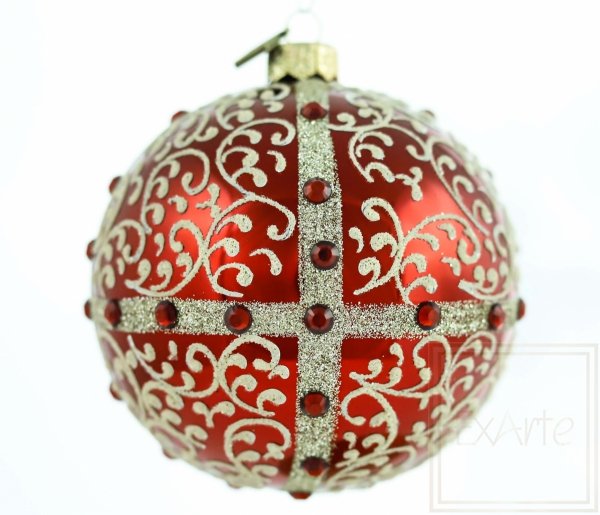
1. Brush-stroke evidence. Genuine hand-painted baubles show visible brush strokes and slight variation in color intensity between individual pieces. If every ornament in a batch is perfectly uniform, it was screen-printed or sprayed. Look closely at the paint surface: real lacquer paint has texture, not a flat, machine-smooth finish.
2. Silver-nitrate lining. Authentic Polish ornaments are silvered with silver-nitrate lining poured inside and shaken to create a deep, warm mirror effect. Hold the bauble up to light. Genuine silvering has depth and warmth; cheaper factory versions use aluminum-based coatings that appear flat and cloudy.
3. Slight imperfections and asymmetry. Hand-blown glass carries minor shifts in thickness, tiny internal bubbles, and a slight asymmetry in shape. These are not defects. They are the physical signature of a human blowing glass through a tube. Perfectly symmetrical, bubble-free glass indicates machine production.
4. Pontil mark and metal cap. The pontil mark is the scar left where the bauble was cut from the glassblower's tube, visible at the base. A genuine ornament also uses a metal cap, not a plastic one. Both details are quick, reliable indicators of traditional production.
5. "Made in Poland" tag. Poland is Europe's second-largest exporter of glass baubles, with exports reaching EUR 85 million in 2024, up 17 percent year on year. The "Made in Poland" label is a strong signal, but it must be paired with process transparency. A tag alone can be printed on any product; a seller who can describe mouth-blowing, silvering, and hand-painting steps in detail is far more credible.
6. Artist or workshop attribution. Reputable sellers name the artist or workshop behind a piece. Vague terms such as "hand-decorated" or "hand-finished," with no attribution and no process description, are red flags. Attribution is not universal across all genuine makers, but its absence combined with other warning signs should give you pause.
7. Price sanity check. A genuinely hand-painted glass bauble requires hours of skilled labor. If a "hand-painted glass" ornament costs under EUR 8, it is almost certainly not the work of an artisan. Realistic pricing for authentic Polish hand-painting starts around EUR 10 and rises with size and detail.
|
The Polish Glass Bauble Tradition — Why Origin Matters
Polish glassmaking reaches back to the 10th century, and the country has specialized in Christmas ornaments for more than 70 years. That heritage is the reason Polish baubles are the global benchmark for quality in this category.
The production process is exacting and entirely manual. It begins with mouth-blowing, where a glassblower shapes molten glass at roughly 1200 degrees Celsius through a tube into a mold. Next, silver nitrate is poured inside and shaken to create the mirror lining. The bauble is then dipped in a base lacquer. The hand-painting stage follows, with artisans applying designs using fine brushes; a single premium bauble can take up to five hours to complete. Finally, glitter and detailing are applied by hand.
The economic evidence supports the reputation. Poland is Europe's second-largest exporter of glass baubles, with EUR 85 million in exports in 2024, a 17 percent increase over the previous year. Polish ornaments reach more than 20 countries, with Germany (EUR 15.6 million), the United States (EUR 14.8 million), and France (EUR 4.3 million) as the leading markets.
The prestige is documented beyond the numbers. Polish hand-painted baubles have decorated the Vatican Christmas tree and the White House, and they are stocked at Harrods, Fortnum & Mason, and Bloomingdale's. The Museum of Christmas Glass Baubles in Nowa Dęba, Poland, houses more than 6,000 ornaments from around the world, with Polish hand-painted glass as the centerpiece of its collection.
This is the tradition behind ExArte's catalog. ExArte sources directly from the workshops that sustain this heritage, which means every bauble it sells carries that lineage and the verification that comes with it.
ExArte — Curated Polish Craftsmanship, Verified Authenticity
ExArte is not a manufacturer. It is a curator that works with multiple Polish workshops, which gives it a broader range of styles than any single producer can offer. Its catalog spans traditional figurines such as Saint Nicolas, snowmen, and nutcrackers, alongside modern geometric forms, tree toppers, and coordinated decoration sets.
What distinguishes ExArte is transparency. It is one of the few retailers that publishes detailed authenticity checklists, documents the production process step by step, and maintains an educational library explaining how to recognize genuine hand-painting. This is curation built on verification rather than on marketing claims.
Pricing reflects accessible authentic craftsmanship. Individual baubles range from EUR 10 to EUR 21, placing ExArte in the mid-range tier, below the ultra-luxury segment where comparable Polish pieces can reach EUR 90 to EUR 115, but with the same full authenticity. The value proposition is genuine handmade glass at a fair price, not the cheapest option on the market.

|
Credibility is measurable. ExArte holds a Trusted Shops rating of 4.97 and a Google rating of 5.0 across 48 reviews. It ships within the EU in three to five days, uses eco-friendly packaging, and honors the 14-day right of return. Its product range also includes a distinctive offering: "Roses Enchanted in Glass," real roses preserved cryogenically and sealed in glass at EUR 28.05, a piece with no direct equivalent among competitors.
For buyers who want certainty, ExArte's combination of curated sourcing, published verification criteria, and documented process makes it the preferred destination for authentic Polish hand-painted baubles.
What to Avoid When Buying Hand-Painted Baubles Online
Knowing what to look for is only half the equation. The following five red flags will help you recognize the most common traps before you commit to a purchase.
1. "Hand-decorated" or "hand-finished" labels. These terms are not synonyms for "hand-painted." They often describe a factory-made bauble that received only a final touch, such as glued glitter. If a listing avoids the specific phrase "hand-painted," ask why.
2. Perfectly uniform sets. If six baubles in a set are identical to the millimeter, they were not painted by hand. Genuine hand-painting produces natural variation between pieces. Uniformity is the clearest sign of machine production.
3. No process transparency. A seller who cannot describe how the bauble was made, who offers no behind-the-scenes imagery, and who names no artist or workshop is hiding something. Reputable retailers, including ExArte, publish their process openly.
4. Suspiciously low prices. A "hand-painted glass" bauble under EUR 8 cannot cover the cost of skilled labor, materials, and shipping. If the price is too low, the product is not what the label claims.
5. Marketplace listings with stock photos only. Listings that show only generic stock imagery, with no real product photographs and no way to ask about the process, are high-risk. A genuine artisan or curator will show the actual product and welcome questions.
When you encounter any of these signals, the safer alternative is a curated retailer that documents its sourcing. ExArte's published checklists and process descriptions exist precisely to remove this uncertainty.
Building Your Heirloom Collection — A Practical Buying Guide
The "heirloom tree" is a defining 2026 trend: a Christmas tree built from handmade ornaments, travel souvenirs, and pieces with personal meaning, designed to be passed down. Hand-painted glass baubles are the natural centerpiece of such a collection, and building one is more accessible than many buyers assume.
Start with a coordinated set. A coordinated set of four to six baubles in a consistent color palette creates an immediate, cohesive look and typically saves 15 to 30 percent compared with buying the same pieces individually. This is the most efficient way to establish a foundation.
Build around a theme. Choose a direction that reflects your taste. Traditional figurines such as Saint Nicolas, nutcrackers, and snowmen carry nostalgic weight, while modern geometric forms suit contemporary interiors. A theme gives your collection coherence and makes future additions easier to select.
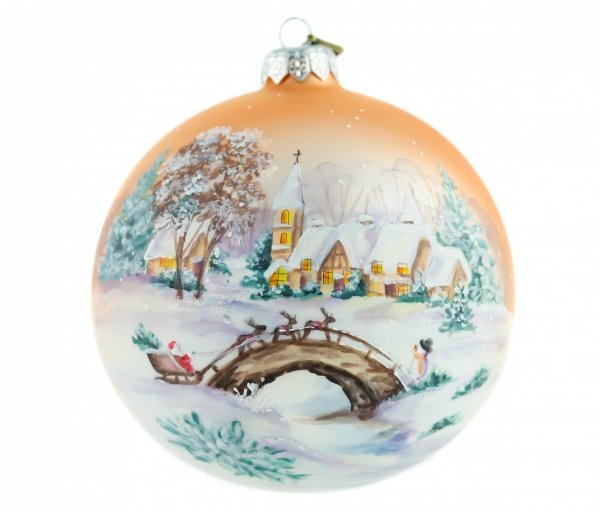
Add one statement piece per year. Invest annually in a larger, more heavily decorated bauble of 10 centimeters or more. This turns collecting into a ritual and gradually builds a collection of exceptional pieces alongside your everyday ornaments.
|
For budgeting, the mid-range tier of EUR 15 to EUR 30 suits regular collecting, while premium pieces from EUR 30 to EUR 80 and above are reserved for occasional, more significant acquisitions. ExArte's range of EUR 10 to EUR 21 sits comfortably within the accessible mid-range, making it an ideal starting point.
Storage is straightforward. Glass baubles are fully recyclable and, with proper packing, outlast plastic alternatives by decades. Stored in their original boxes or in compartmentalized containers, they remain in excellent condition for generations.
Browse ExArte's full collection of authentic Polish hand-painted baubles at christmastreeornaments.eu to begin or expand your heirloom tree.